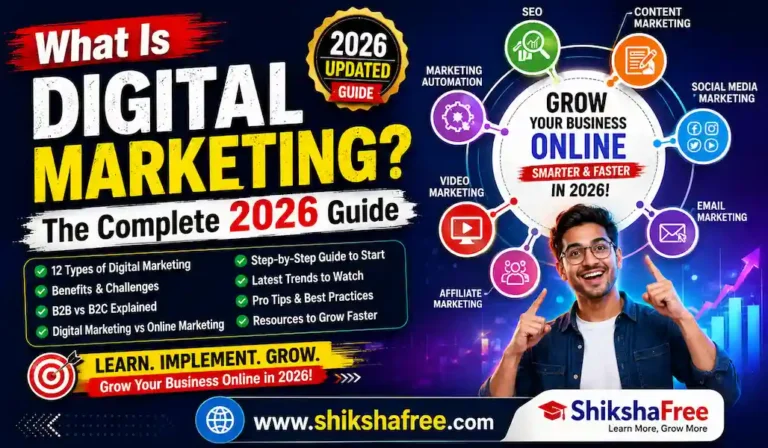

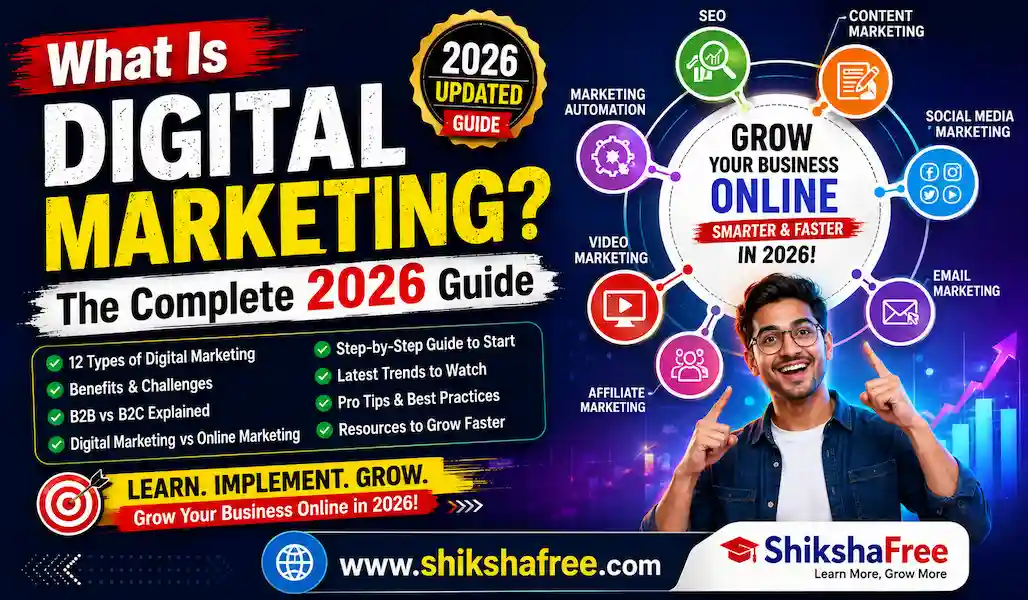
What Is Digital Marketing? Explore this complete 2026 guide to understand digital marketing, its major channels, benefits, challenges, strategies, and latest trends.
Table of Contents
What Is Digital Marketing? The Complete 2026 Guide
Digital Marketing you have probably heard the term multiple times before but do you really realize how much digital marketing has to do with your daily life?
Well, if you have a small business and you want the name of that small business to get out there and be known then you can turn to doing things like an Instagram post or a Google ad or you can make a website and get into email marketing or you can make your website come up on the first page of Google. All of these things are what we call digital marketing.
Even outside of owning a small business, we encounter digital marketing everyday; searching something on Google, scrolling through Instagram, watching videos on YouTube, checking our emails, shopping online, etc.
In this course we will first introduce you to the concept/theory of digital marketing and then slowly move towards the more important parts of it. No matter where you are at, if you are a fresher, a student, a business owner or you just want to learn what we mean when we say the word digital marketing this course will cover everything in a very simple yet efficient manner.
What Is Digital Marketing? A Quick and Easy Explanation
You’ve built a wonderful bakery that serves world class cakes… nobody has heard of you! Marketing bridges the gap between you and those looking for exactly what you provide.
So what’s Digital Marketing?
Digital Marketing can be defined as the promotion and/or advertising of a business, product/service or a company image to an online audience using digital mediums such as websites, Google (or other search engines), social media platforms, email newsletters, apps and advertisements placed on various web sites.
In short – it’s a way of connecting businesses with potential customers who hang out online. Think of the difference between TV/radio/newspaper/poster advertisements versus Google/Instagram/email newsletter advertisements – same principal just done over a number of different mediums.
Difference Between B2B and B2C Digital Marketing You Should Know
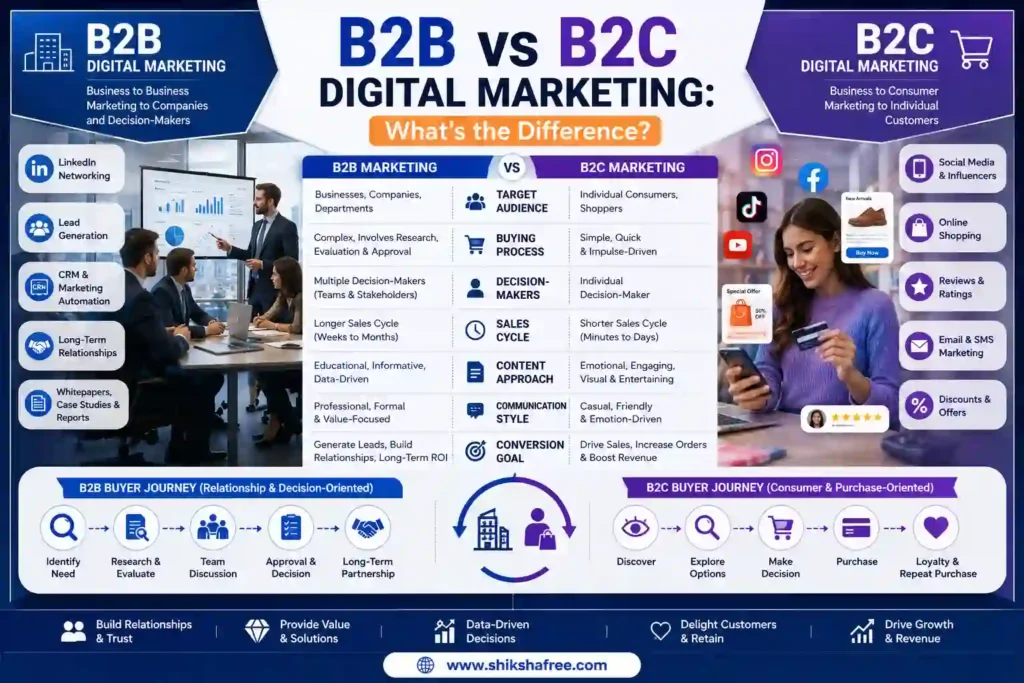
Not all companies address the same category of customers. In particular, this nuance falls under the B2B & B2C concept, the specifics of which will be discussed below.
First, in general, it should be noted that the terms B2B and B2C mean totally different things. Under B2B, a concept abbreviated from business-to-business, the selling of goods or services between two companies is implied. This is a transaction when one business sells to another. An example of such a transaction is the provision of software products to enterprises. The peculiarity of B2B marketing is that businesses fall under this category; therefore, in marketing communications, emphasis must be placed on professionalism and rational argumentation. It is advisable to use LinkedIn and email marketing as tools for attracting customers.
In turn, B2C, that is, business-to-consumer, is a business model in which the seller is a company and the buyer is an individual. The key difference between B2C and B2B is that in the first case, the customer is an ordinary person who determines his or her choice much more emotionally than a business person does. Therefore, the marketing strategy should have a more emotional effect because people rather often choose what they like. Moreover, in the B2C marketing system, social networks and video resources are used much more often.
By the way, there is a rather significant nuance in these two concepts. The fact is that many companies operate both B2B and B2C at the same time. For example, printing houses are examples of companies that provide services to businesses, organizations, and ordinary people. Therefore, in each specific case, it is rather important to identify the target audience so that the marketing strategies are implemented correctly.
The Key Benefits of Digital Marketing
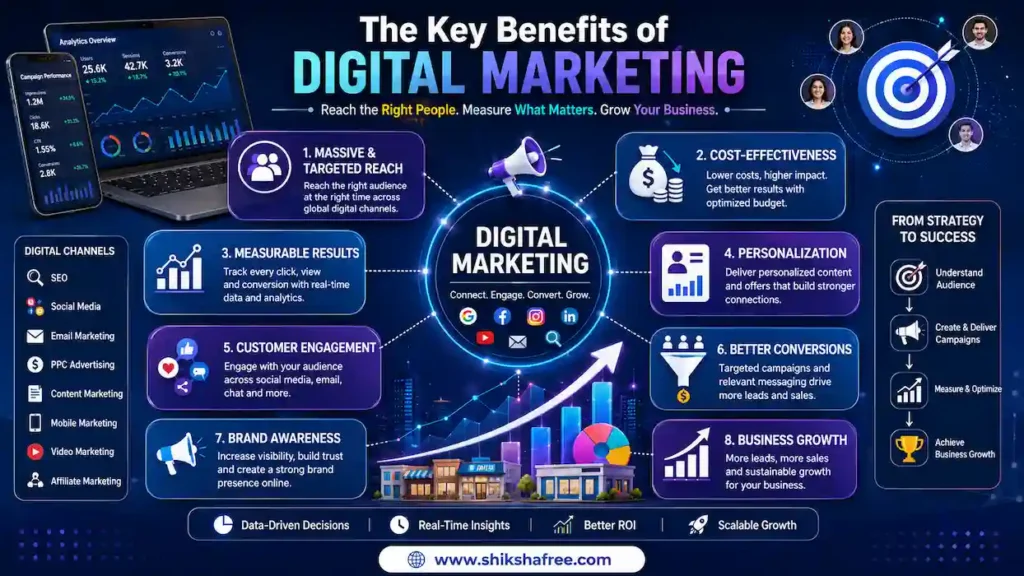
Here is a truth based on my personal experience for more than ten years in the sphere: those who dare to invest into digital marketing see results in the form of a business growth. Those who refuse to do so, eventually disappear from the market, even if they had a great product.
Digital marketing is vital for any company that wants to scale and grow exponentially. The benefits of investing into it are numerous, tangible, and impossible to be replaced by any other marketing strategy. Therefore, each business owner should know about them and understand how they can be applied to their own business.
I will list them below in a simplified manner.
Reach a Massive and Targeted Audience
Using traditional media you can advertise and hope people will pay attention. With digital marketing you can specifically target the people that you want to see your advertisement. You have the ability to target everyone from age group to locations and hobbies and professions. A small business like a bakery can target the people that are within a five-mile radius of their bakery that are interested in desserts. This kind of precision simply hasn’t been possible before the digital age.
It Is Extremely Cost-Effective
Running a TV commercial can cost thousands of dollars. With digital marketing anyone can start from just a few dollars a day. Even social media, SEO , and email marketing can bring thousands if not millions of dollars in profits over time. I myself have seen small start up companies beat big name companies by using their money wisely in the digital marketing world. Digital marketing can be very beneficial to every business no matter the size.
Your Results Are Always Measurable
One of the problems with traditional marketing is the lack of information. You simply cannot know for sure whether a newspaper ad or a billboard brought in customers. With digital marketing, on the contrary, each action is measurable and therefore marketing campaigns are highly transparent. By looking at a couple of simple reports, any business owner can know how many visitors his website gets, how many clicks his ads secure, and how much revenue his campaigns generate.
Personalize Your Marketing for Every Customer
Imagine going to a store and the salesperson knows your name, your likes and dislikes, and what you are interested in buying. Such an example is what digital marketing can provide to online stores. First of all, you can send personalized email marketing to your customers. Secondly, it becomes possible to offer different products to different customers. These two factors allow you to build close relationships with your clients and make them return to buy again and again.
Connect With Customers Throughout Their Buying Journey
Here is one interesting thing that many newcomers are not aware of – a customer seldom buys a product on his first visit. Consider your own experience – you look at the product, you think about it, you research, you compare, and only then you make the final decision to buy.
This entire process is known as the buying journey. Moreover, digital marketing is great in this regard because it allows interacting with a customer at every stage of their journey.
For example, when they become aware of your brand for the first time (e.g. read your article), consider buying from you (e.g. reads your other blog posts on the topic), and make the final decision (e.g. use your newsletter to get a discount).
Every step has its marketing activity to engage the customer and lead them to the next stage. Thus, a blog article can help at the first stage, an email campaign can help at the second, and a special offer for subscribers can persuade the customer to make the purchase. In other words, digital marketing is one of those rare things that are strategically perfect in all stages of the sales cycle.
In simple terms, you can understand that all online marketing forms part of digital marketing. However, there’s an aspect which makes both different from each other. And this is exactly what we want you to remember.
Turn Website Visitors Into Paying Customers More Easily
Getting people to come to your page is one thing, but getting them to do what you want is another. That is why the conversion in digital marketing is so valuable, and many organizations and companies are striving to achieve it.
An example will illustrate the importance of conversion in digital marketing. Suppose 1,000 people visit your website, but only 5 have made a purchase. What you can do with conversion is improve the chances that the other 995 will convert from website visitors into paying customers. Digital marketing can help you do just that.
You can do things like install call-to-action buttons that encourage customers to make a purchase, create landing pages that are designed to convince people to buy your product, and target those that have visited your page but did not make a purchase with retargeting advertisements.
A slight increase in conversion can lead to a significant increase in income. It is this idea, among others, that leads many digital marketers to devote time and effort to increasing the number of conversions. It is also this idea that makes many digital marketers successful.
How Digital Marketing Supports Your Business Goals
Any company has its goals. Some companies want to increase sales; some want to build the brand image, and some want to grow the email list and promote a product launch. Regardless of the goals, digital marketing will help achieve them. I will show how digital marketing can address different needs and explain why it is essential to establish the goal in the process.
If you want to boost sales, then investing into target advertisement & optimizing your pages around related products can be great options.
If the goal of the company is about improving their brand image / increasing its visibility on the internet, investing into producing content for social media & uploading videos to YouTube could help a lot.
It might be the case that the company wants to make its own ecosystem and keep customers in its system by email to communicate with them more often. Therefore, based on the above examples, it can be concluded that different goals require different approaches in digital marketing.
Thus, the essence of digital marketing is that it is a complex of various instruments that can be applied in different combinations depending on the needs of the company in question. Secondly, it is vital to understand that the initial step is to define the objective; you need to have a clear vision of the result you want to achieve. In this way, digital marketing will become a driving force that will help you achieve the desired result.
The advice I give to my clients is that they need to understand their needs and clearly define the objective, and then develop strategy, on which their further steps will be based, according to it. In the end, everything will lead to the result, and the results will justify the chosen strategies.
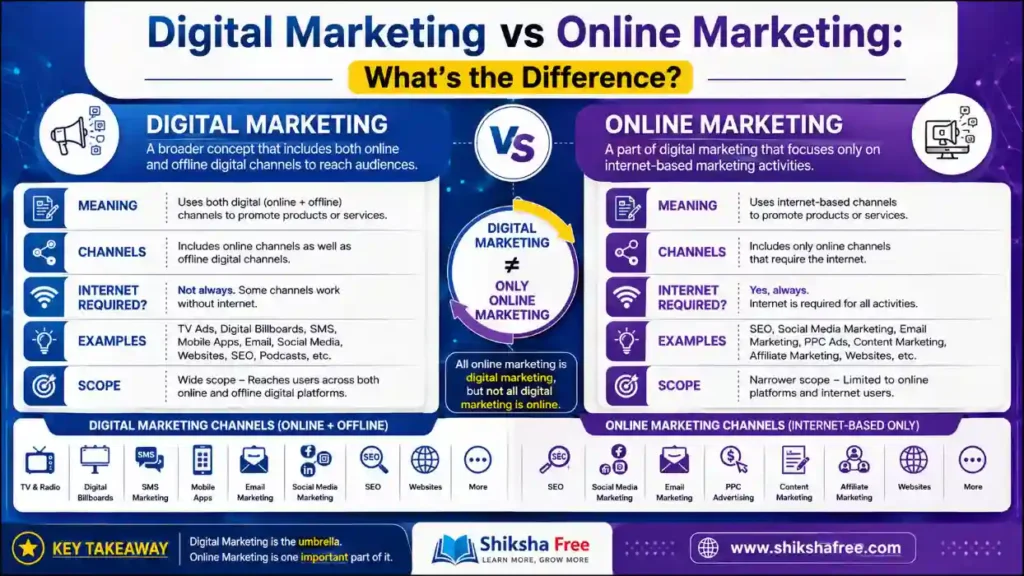
Digital Marketing vs Online Marketing: What’s the Difference?
The number one question I get asked from our students and people on the marketing listservs is “What’s the difference between SEO and SEM?” This topic baffles seasoned marketers, too.
Let me explain how they are similar yet different (and why you should care).
What Makes Digital Marketing Unique?
Digital marketing is the broader term. It includes all forms of marketing done through digital devices and channels — whether those channels are connected to the internet or not. For example, SMS marketing, digital billboards, and TV ads on smart screens are all part of digital marketing. Even offline digital signage in shopping malls falls under this category. Digital marketing simply means any marketing that uses a digital medium to deliver the message.
What Is Online Marketing?
As mentioned above, online marketing is basically considered a subset of digital marketing.
The term ‘online’ here suggests anything related to internet marketing activity. For example SEO, Social Media Marketing, Email Marketing, Content Marketing, Paid Online Ads and similar others are covered under this category.
Common Digital Marketing Challenges and How to Overcome Them
While digital marketing seems really cool and interesting, we cannot ignore its many challenges. As someone who has spent years working in this field, I can tell you that many companies struggle with some of the below problems when they enter into the world of digital marketing.
Let’s start discussing the challenges One By One
Challenge 1 – There are way too many channels and no focus on what you’re doing (and not doing). So often, I see beginning marketers trying to put their eggs in every basket at once. “I’m going to put money behind Instagram,” they say. “But wait, let me also invest in YouTube because why shouldn’t I?” This mindset ends badly for them as they spread themselves out thin and end up failing to be good at anything they do.
The answer to this problem is to only choose 1-2 channels where your target audience spends most of their time online and become an expert there before branching out further than necessary.
Challenge 2 – You aren’t seeing results fast enough. When diving headfirst into the ocean of digital marketing, people might think everything will happen overnight without effort. If you want results from things like SEO or content marketing campaigns though, it takes time! One mistake beginner marketers make constantly is giving up way too soon after launching new strategies or tactics which leads them nowhere closer towards achieving success than ever before
Challenge #3 – Keeping up with constant changes. Algorithms are changing. So are platforms. And there’s always new stuff coming out every month. One of the keys to staying ahead in this industry is simply keeping on learning. Follow some trustworthy sources. Take courses. Don’t be afraid to test things.
Challenge #4 – Measuring wrong metrics. It’s easy for many businesses to become obsessed with how many “likes” they got or how many followers they have on a particular platform. But unless you’re selling digital products or online services, these metrics mean nothing if they don’t translate into actual revenue (or conversions). Always measure what actually matters most to your bottom line.
12 Different Types of Digital Marketing You Should Know
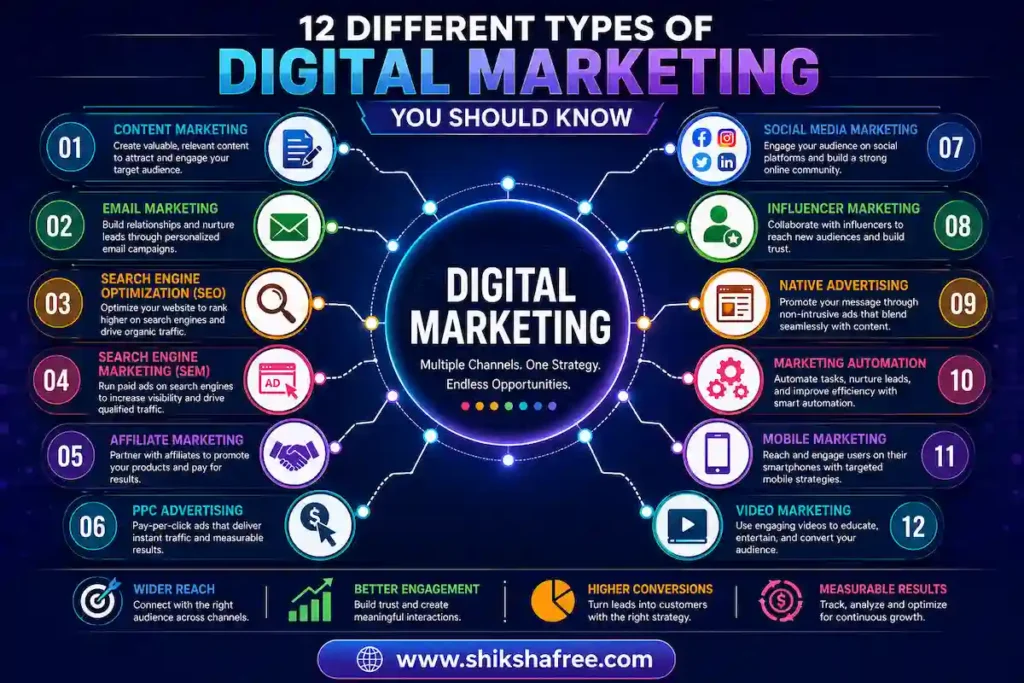
Digital marketing is not just one thing. It is a collection of many different strategies and channels — each with its own strengths. Over the years, I have worked with almost all of these types. And I can tell you — the best results always come when you combine the right ones together.
Let me walk you through all 12 types clearly and simply.
Owned Marketing Channels
These are the channels your business fully owns and controls. No algorithm can take them away from you overnight.
1. Content Marketing: Get Customers By Providing a Great Contribution
Content marketing refers to creation of what is interested, helpful for your list. The best candidates here are blogs, tutorials, infographics, videos and some others. The intuition of such a strategy is producing a lot of valuable content until people will associate value with the brand.
For example, if people will find your blog content valuable, then it will have a mental association with your brand name, by creating a fan base eventually ready to buy the products of that brand.
2. Email Marketing: Make a one on one connection with your customers
This has, even with all new trends in digital marketing, one of the highest returns. When you manage to get access to a customer’s inbox, you will be able to provide him with useful info with regards to offers that are suitable for him.
You could personalize offers, newsletters, product updates, and discounts directly to them. And unlike platforms such as social media, your email list is yours alone—no one will come around asking you to stop using emails to reach people.
The good news? Businesses can expect upwards of $36 returned for every dollar invested into an email campaign.
SEO: Improving Your Website’s Google Rankings
SEO is an abbreviation for “Search Engine Optimization.” Basically, SEO helps optimize your website to rank highly when someone searches for related terms (like on Google) – and doesn’t require paying for ads.
Everyday, you’ll receive a flood of free, high-quality traffic to your site if you can land on the top results page on Google with relevant keywords. SEO includes things like great content creation, improved site speed, backlinking, and being mobile friendly.
Although it’s hard to measure the benefits immediately, there’s no denying that SEO pays off big over the long haul.
Paid Marketing Channels
These channels require a budget — but when done right, they deliver fast and measurable results.
4. Search Engine Marketing (SEM): Getting Instant Visibility on Search Engines
The paid version of appearing on search engines (Google) is called SEM. With this you pay to appear on the top of search engine result pages for specific keywords. So whenever anyone searches for those keywords, your ad will show up instantly.
This works perfectly well if you can’t afford to wait months and months until your SEO efforts start showing up. It’s a very fast, very effective way to get instant traffic as long as your campaigns are properly set up with relevant keywords and ad copy.
5. Affiliate Marketing: Sales through your partners.
The simplest definition of affiliate marketing is having dozens of sales people who you pay nothing to until they actually make a sale FOR you.
You partner with bloggers/influencers/website owners and market your product for them. They can then sell it to their customers through a referral link and get a commission when someone buys through their link. Win win win.
You don’t have to pay huge ad budgets up front (until you’re certain it’s going to sell!) and you give them cash for promoting something they know and believe in. To be totally honest? A LOT of massive online brands (in e-commerce) have made absolute BANK doing affiliate marketing.
6. PPC Advertising: Paying for Targeted Website Traffic
What does PPC stand for? Well, that’s a great question! In simple words, PPC means “Pay Per Click.” With this model, you’ll get paid when some clicks your advertisement.
On the contrary, with traditional advertisements, you’d have been charged regardless of engagement. PPC ads show up on Google, Facebook, Instagram, LinkedIn, and all sorts of websites.
The primary benefit of using PPCs is that you gain full control. From setting your budget, audience target, and what to put into the message. And even if you set aside an insignificant amount daily, it will bring tons of visitors to your site who are very much interested in your content.
Earned & Organic Marketing Channels
These channels grow through genuine effort, relationships, and great content — not paid placements.
7. Social Media Marketing: You Build Your Brand by social platforms,
It refers to brand awareness and connection with audiences by various social platforms like Instagram, Facebook, Linkedin, TIKTOK and X( twitter). It can involve writing quality content that users love, and also sharing the content, replies to comments, polls, etc., in these platforms in order to build a zealous fan group for your brand that turns out to be a paying customer over time. In social platforms, we create connections, build trust and finally turn the relationship into a revenue stream.
8. Influencer Marketing: You Reach New Audiences by content creators,
It refers to an arrangement between a brand and someone who influences other people to buy products or subscribe to services. It can be a mega star and could also be micro-influencers (like 10K followers).
Why should we do that?
Because a trustworthy influencer suggests to people that the product recommended by him is like being suggested by a friend, and people seem to trust more than an advertisement that, for example, brand ads.
The audience puts more trust in a recommendation from a friend than from someone who just knows brand ads. Moreover, in 2026, micro-influencers are more popular since their audience is extremely engaged and targeted to be very specific.
9. Native Advertising: You promote with natural approach,
Native ads will seamlessly merge in the platform that they are on-may it be the social platform, video content or web. These are not your typical ads. They are genuine content such as an article, a social media post or a suggested video.
Users naturally interact with native ads, which does not disturb their experience. Typical uses are sponsored articles on new websites and promoted posts on social media feeds. If done well, it has been proven to drive real value for the audience while also advertising the brand naturally and effectively.
Modern Digital Marketing Methods
These are the newer and smarter ways businesses are marketing in today’s fast-moving digital world.
10. Marketing Automation: Saving Time With Smart Tools
Marketing automation involves the application of technology that allows you to automate your regular marketing processes. Instead of sending your emails and posting on social media daily, you only do it once and leave it to run automatically.
It deals with sending welcome emails, setting follow-ups, birthday deals and so forth. It also monitors cart abandonment that could be a potential source of loss of sales.
Automation marketing tools are available easily through such tools as MailChimp, HubSpot or Active Campaign.
11. Mobile Marketing: Reaching Users on Smartphones
In 2026, over 60% of all internet traffic will come from mobile devices. In this environment, mobile marketing is the process of designing specific marketing strategies with smartphone users in mind.
This includes everything from SMS marketing and push notifications to mobile-optimized websites and in-app advertising and location based marketing. If your website or content isn’t optimized for mobile then you’re likely missing out on more than half of your potential audience. Today mobile marketing isn’t an option, it’s essential.
12. Use Video Marketing To Engage Your Audience
We live in a world where videos represent the number-one consumed form of online content in recent years. Think about the popularity of YouTube, TikTok, Instagram Reels, and even Facebook videos. It’s only natural that consumers have begun flocking to these video marketing platforms.
When you start incorporating videos into your business, you’ll inevitably be able to educatere-inspireand convinceyour customers with eye-catching and informative content.
With even one quick product demo, you’ll notice enormous jumps in customer conversions. The more “behind-the-scenes” you allow potential clients to witness of your business operations and processes-you will earn their authentic trust-they won’t even need prompting!
An educational tutorial shows off your knowledge base and helps position your brand as an industry expert.
Overall, I’m really excited about the power that video marketing has given us—and I definitely think it will continue to grow and evolve. Businesses who use video marketing right now in 2026
Step-by-Step Guide to Starting Digital Marketing In 2026
Knowing about digital marketing is great – but knowing how to get started? That’s when the real magic happens.
Over the years I’ve helped countless people kick off their very first digital marketing strategy from scratch – and each time we’ve followed these 7 simple steps which are the perfect starting point for building your own.
Set Clear Marketing Objectives
Setting up goals Before even thinking about methods of digital promotion, first think clearly about your targets. You just want much traffic onto your web pages, perhaps a whole lot more sales of any products, also a full lot more of many electronic mailing subscribers? Be sure that the targets they’re often exact and measurable.
You need 5 thousand for website users every month contained in the 2 yrs that don’t perform simply ‘I must make visitors‘.
Knowing Who the ideal customer might be:
The particular advertising strategy to every person. The most suitable person could definitely ‘ t really make it. You have to determine precisely his or her/woman age group, trouble issues he / she encounters, platforms it uses standard, content forms like to watch for such things. A good, precise person definition can significantly support someone to build advertising content that appeals to the target audience, therefore there might be an even better effect .
Plan Your Digital Marketing Budget
Start by considering money factors. Think about how much you want to invest every month.
It’s always a good idea to divide your budget between the paid channels (for instant results) as well as the organic ones (to grow over time). Also remember to keep an eye on things so that you don’t pour all your money into one thing only.
You need to start with something smaller, experiment with different strategies and once you find out which works better, spend more of your cash on them. This kind of smart budget planning makes sure that no hard-earned money goes to waste, while also ensuring you have a working marketing system in place for the long haul!
Choose the Right Marketing Channels
Based on our research into who makes up our audience, we need to determine which platforms they use the most. For example, if our target customer base consists of professionals, it’s best to focus our attention on LinkedIn & Email Marketing.
If what we offer looks great in pictures, chances are we can do well by focusing more attention on Instagram & Pinterest. It doesn’t make sense for us to spread ourselves out over many platforms. Let’s start off on two or three channels first before expanding further.
It will save us countless hours (and dollars!) later when we figure out which channels we should have focused on initially.
Make Your Website Mobile-Friendly
In this day and age, all your marketing activities end up bringing traffic back to your website. Therefore, if your website isn’t fast, easy-to-navigate, or doesn’t work well for mobile users, you’ll lose those visitors right away.
Make sure that your website loads within 3 seconds. Make sure that all buttons are easily clickable from a phone’s screen. Ensure that your website is easy to read without needing to zoom out. A great user experience with your website should be at the core of your successful digital marketing strategy in 2026.
Track Performance and Improve Results
Never sit on your laurels once you start running your campaigns — always track your performance week-on-week.
You can use free tools such as Google Analytics & Google Search Console to see which pages drive the most traffic and which ads convert into more sales, plus which emails have the highest open rates. Use this insight to help inform your decision-making process going forward.
Digital marketing isn’t a ‘set-and-forget’ system. Like all great things, it’s an ongoing cycle that demands continuous testing and improvements. This is how we achieve true growth.
Build a Consistent Multi-Channel Strategy
Most of the most successful businesses aren’t limited by a single marketing channel. The top brands are visible consistently on different platforms.
Your blog content, social posts, emails, and advertisements all speak with one consistent voice and deliver the same message using the same branding elements. Consistency helps build strong customer relationships. Trust is earned when you’re always there where your customer is online — eventually turning those trusting customers into devoted, lifelong buyers for your business.
Emerging Digital Marketing Trends to Watch
As always with digital marketing, nothing stays the same forever. With AI-powered personalization, there’s a lot going on in this space — brands are leveraging artificial intelligence to provide hyper-personalized experiences for every one of their users (from personalized product recommendations to custom email content). And if we’re being honest, we’d argue it has become an expectation rather than just a nice-to-have.
With the continuing rise of voice-enabled assistants like Siri, Alexa, and Google Assistant, increasingly more internet searches will be voice-enabled; consequently, you need to optimize your content for this more conversational style of search as people try to find their answers.
Dominance of Short-Form Video- In the rise of TikTok, Instagram Reels and YouTube Shorts as dominant forces in video content, an emphasis on producing authentic and engaging video that appeals to audiences organically is key for brands to get maximum visibility.
The Arrival of Zero-Click Searches – Google is providing more and more direct answer to everyday queries on its SERPs, making sure to rank on these Featured Snippets is key for any brand hoping to even be seen.
The Power of Community Led Marketing: When brands cultivate true communities (via things like private Facebook groups, Discord servers etc.) customers develop an unparalleled loyalty towards them that’s hard to generate via traditional forms of advertising.
Digital Marketing Resources to Grow Faster
You might feel intimidated by all this talk about learning digital marketing but don’t worry – some of the best resources in the world are free! And trust me when I say these are my favorite picks after 10+ years of personal experience with them!
Google Digital Garage – Completely Free Platform By Google To Learn Digital Marketing Fundamentals
HubSpot Academy – Free Certifications On Inbound Marketing, Email Marketing, Content Marketing, & More From One Of The Industry’s Most Respected Platforms
Google Analytics Academy – If you want to learn how to read & understand your data properly, this should be on your list. It’s also one of the most valuable skills any digital marketer can have.
Moz Blog And Ahrefs Blog – These blogs provide excellent insight into learning about SEO more deeply, including some incredible insights that even experienced marketers will appreciate!
Neil Patel’s Blog – For anyone looking for good digital marketing tips they’re easy to follow and implement quickly—even if you’re just getting started!
So what’s the most important investment I could make? Well, as always, my answer was to invest in myself. To become an expert at Digital Marketing requires you to be curious about everything going on around you, always be eager to learn more, and willing to experiment constantly – and guess what? It worked for me! (And it will work for all of you too!)
You now know how to start understanding Digital Marketing from scratch. The world is online. Your audiences are online. With the right Digital Marketing strategy in place, they’ll find you every day. So go get those people!
About the Author