
Stand outside any school gate in March and ask the parents waiting there what’s really been keeping them up at night, and you won’t hear much about uniforms or bus routes. You’ll hear about the board. CBSE, ICSE, or the state board — for a lot of families this feels like a decision that quietly locks in the next ten years, and most people end up making it on secondhand information. A cousin’s opinion here. A neighbour’s success story there. Whatever got forwarded in the parents’ WhatsApp group that week.
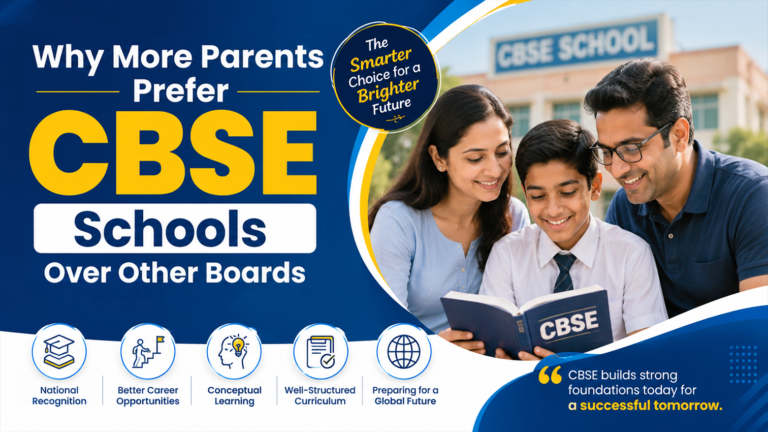
The question of CBSE schools in India comes up in almost every one of these conversations, and it deserves a better answer than “because everyone else is doing it.”
So here’s a more honest one: CBSE has quietly won on a few things that matter enormously to Indian families, and it’s given up a little ground on things that matter far less to them. Once that trade-off is clear, you stop picking a board out of habit and start picking one on purpose. In Rajasthan especially, parents tend to weigh this carefully before shortlisting the Best CBSE School in Sikar, because the whole academic culture of the town has grown up around competitive exam outcomes — and what a child studies from Class 9 onward feeds directly into that pipeline.
The Entrance Exam Link Nobody Says Out Loud
There’s a structural reason behind a lot of this, and school brochures rarely say it plainly. India’s biggest entrance exams — JEE Main, JEE Advanced, NEET UG, and a large chunk of CUET — are built on syllabi that track closely to NCERT textbooks for Classes 11 and 12. CBSE schools teach those exact books as their core curriculum. Not “similar” books. The same ones.
That single overlap explains more parental behaviour than any marketing pitch ever could. A CBSE student preparing for NEET isn’t juggling two separate bodies of knowledge — the school syllabus and the entrance syllabus are largely the same material, just covered at different depths in different rooms. A student on another board, though, often ends up learning their own board’s version of a topic and then relearning the NCERT version separately, just for the entrance exam.
For a family with a child aiming at medicine or engineering, that duplication eats into time nobody has to spare. It’s exactly why coaching institutes across Kota, Sikar, and Hyderabad build their entire question banks around NCERT lines — and why so many parents quietly treat CBSE enrolment as step one of a much longer plan.
Mobility: The Reason Transferable Families Rarely Switch
CBSE’s own numbers are hard to argue with — more than 24,000 affiliated schools across India, plus roughly 240 spread across 26 countries. For a defence family, a bank employee who gets posted every few years, a railway household, or really anyone whose job means moving every three years or so, that footprint is basically the whole argument by itself.
A child who moves from Jaipur to Guwahati halfway through the school year usually walks into the same chapters, the same style of testing, sometimes even the same textbooks. A few things that make this easier in practice:
- Transfer certificates and admission processes stay fairly consistent across affiliated schools.
- Families posted overseas can often just continue on the same board instead of starting over.
- Siblings in different cities stay roughly in step academically, which makes shared tutoring or study material actually worth using.
State boards vary quite a bit from one state to the next — in sequencing, medium of instruction, exam calendars, all of it. There’s nothing wrong with that. They’re built for students who plan to stay put. But it does make a mid-schooling move genuinely disruptive, and that’s the trade-off families are really weighing.
The 2026 Exam Changes Have Shifted the Pressure
This is probably the freshest part of the whole picture, and it’s changed how a lot of parents feel over just the past year.
Starting with the 2026 session, CBSE has moved Class 10 to a two-attempt system. The first exam, held in February, is compulsory for every student. The second, in May, is optional — meant for anyone who wants to improve a score or clear a compartment — and whichever result comes out better is the one that counts. Prasar Bharati’s coverage of the announcement noted that students can attempt improvement in up to three subjects from Science, Mathematics, Social Science, and languages, with results for the two phases landing in April and June.
Alongside that, the board has been steadily raising the share of competency-based, application-style questions — the kind that ask a student to actually reason through a situation instead of reciting a definition back.
What does this mean for parents in practical terms?
- A bad day doesn’t wreck the whole year anymore. Illness, a family emergency, nerves in the exam hall in February — there’s a genuine second chance in May.
- Less memorising, more understanding. And conveniently, that happens to be exactly the skill entrance exams reward too.
- Attendance rules haven’t gone soft. The 75% requirement still stands, and skipping the main exam without a valid reason can cost eligibility for the second attempt.
- Internal assessment now carries fixed weight, so steady classroom work actually counts for something instead of everything riding on three hours in March.
This wasn’t a decision made in a vacuum, either. It lines up with the broader policy direction, and the board’s exam controller noted at the time that a clear majority of surveyed students were in favour of the two-exam structure — even if teachers, understandably, were a bit more cautious about it.
The Unglamorous Reason CBSE Keeps Winning
Here’s a reason that never makes it into any prospectus: the sheer size of the ecosystem built around CBSE.
Sample papers, previous years’ question sets, reference guides, YouTube explainers, doubt-solving apps, private tutors — all of it exists in far greater volume for CBSE than for almost any other board. A parents living in a small town who cannot afford private tutors is likely to have access to just as much up-to-date material on the subject her child is studying that week as the most successful coach. Simple but powerful truth that is not always easy to grasp.
Fees also tend to land somewhere between state-board schools and international curricula. And because so many teachers are already trained on the CBSE pattern, schools find it easier to hire staff who understand the assessment style from day one — which shows up in the classroom as fewer surprises when exam season finally arrives.
Where Other Boards Genuinely Do It Better
Any article that paints CBSE as flatly better than everything else is trying to sell you something. It isn’t, and pretending otherwise doesn’t actually help parents.
ICSE and ISC push students toward deeper written expression, wider reading, and a stronger command of English. Kids coming out of that system often write essays and long-form answers with noticeably more confidence, and the culture around internal assessment and project work tends to be more developed. For a child leaning toward law, journalism, literature, or design, that grounding is a real asset — not a nice-to-have.
State boards, RBSE in Rajasthan included, deserve a lot more credit than they usually get. Teaching in the regional language helps many first-generation learners actually understand concepts instead of memorising translated versions of them. Fees are typically lower, the syllabus often lines up well with state-level recruitment and scholarship exams, and results at the top end are genuinely competitive. A child who’s comfortable learning in Hindi medium may well outperform an English-medium peer covering the exact same content.
IB and Cambridge programmes lean into inquiry-driven learning and are widely recognised by universities abroad. For families planning undergraduate study overseas, these can be the better fit — though cost and limited availability rule them out for most.
The real question was never “which board is the best.” It’s “which board fits this particular child, in this particular family, with this particular plan.”
A Checklist Before You Commit
Choosing the board is only half the decision. Two CBSE schools sitting a few kilometres apart in the same town can produce wildly different outcomes. Before signing anything, it’s worth checking:
- Affiliation status and category — verify the school’s affiliation number directly on the CBSE portal, not whatever’s painted on the signboard outside.
- Whether the affiliation covers senior secondary — some schools are only affiliated through Class 10, which forces a transfer right when it’s most disruptive.
- Teacher qualifications and how long they actually stay — high turnover in Physics, Chemistry, Biology, or Maths is worth noticing before you enrol, not after.
- Class 10 and 12 results across the last three years, not just this year’s topper photo pinned to the noticeboard.
- Labs, library, and sports facilities that are genuinely in use, not just the ones on the guided tour.
- The school’s real approach to competitive exam prep — some offer integrated support, some have tie-ups with coaching centres, some stay fully hands-off. None of these is automatically wrong, but you should know exactly which one you’re signing up for.
- The full cost, not just the headline tuition — books, transport, uniforms, activity charges, exam fees, all of it added together.
Conclusion
There isn’t a single “best” board for every child, and pretending otherwise is where a lot of parents go wrong. The right choice depends on your child’s temperament, your family’s mobility, and where you see them ten years from now — not on what worked for the neighbour’s kid.
That said, it’s not hard to see why CBSE keeps pulling ahead for so many households. It offers national consistency for families who move. It lines up almost perfectly with the country’s biggest entrance exams, saving students from learning the same material twice. And the 2026 reforms have made the system noticeably less punishing — a single bad day in February no longer has to define a child’s entire year.
If relocation is part of your family’s reality, if competitive exams are somewhere on the horizon, or if you simply want a board with a certificate that’s recognised almost everywhere, CBSE is an easy default to understand. But it’s still a default, not a rule. A child who thrives in their mother tongue, who’s drawn to the humanities, or who’s already set their sights on a university abroad might genuinely be better served by ICSE, a state board, or an international curriculum instead.
Pick the board that fits the child in front of you first. Then pick the school with care — because that second decision is the one that actually determines how the next ten years feel, day to day, long after the admission form is forgotten.
FAQs
Q.1 Is CBSE easier than ICSE?
Not easier exactly — just weighted differently. CBSE keeps the core syllabus tighter and more exam-focused, while ICSE asks for broader reading and longer written answers, especially in English and the humanities.
Q.2 Does CBSE really help with NEET and JEE prep?
Yes, mostly because both entrance syllabi track closely to NCERT’s Class 11 and 12 textbooks, which CBSE schools are already teaching. Students skip the step of learning the same material twice from two different sources.
Q.3 What is the CBSE two-exam system starting in 2026?
Class 10 students now sit a compulsory exam in February and have the option of a second attempt in May. Whichever score is higher counts, which allows for improvement or compartment clearance without losing a full academic year.
Q.4 Can my child switch from a state board to CBSE partway through school?
Yes, though timing matters a lot. Switching after Class 8 or before Class 11 tends to go smoothly. Doing it mid-Class 10 or mid-Class 12 creates syllabus gaps that are genuinely hard to close in time.
Q.5 Is CBSE recognised by universities abroad?
Broadly, yes. CBSE Class 12 results are accepted by universities across the UK, US, Canada, Australia, and Europe — though individual institutions may still ask for additional standardised tests or English proficiency scores.
Q.6 Which board suits a child who isn’t especially academically inclined?
Teaching quality tends to matter more than the board itself here. CBSE’s skill-based subjects and competency-focused papers help to a degree, but a patient, supportive school makes a bigger difference than the name on the certificate.
Q.7 How do I actually verify a school’s CBSE affiliation?
Head to the official CBSE affiliation directory on cbse.gov.in and search by school name or affiliation number. While you’re there, confirm both the affiliation category and whether it extends up to the senior secondary level.
About the Author