
NEET Counselling 2026: Complete Step-by-Step Admission Process
Clearing NEET is only the first half of the job. Every year, students who scored well enough to walk into a government medical college end up somewhere they didn’t plan for — a private college, a lower-preference seat, or sometimes out of the process altogether — simply because they misread a deadline, ticked the wrong option, or assumed someone would call to remind them. Nobody calls. NEET counselling 2026 is the process through which a rank transforms into admission, and it rewards those who know the game rather than those who have bled on the battleground.
The National Testing Agency declared the NEET UG 2026 result on 16 July, with roughly 11.21 lakh candidates qualifying out of the nearly 20 lakh who sat for it. That’s a large number chasing a comparatively small pool of seats, which is exactly why the counselling process matters as much as it does.
This guide walks through how the whole thing actually plays out — who runs which part of it, what the round-wise calendar looks like, how the newly introduced Freeze and Float system works, what you’ll end up paying, what documents you need on hand, and where students most commonly lose ground. Students at the Best NEET Coaching in Sikar usually get a counselling briefing folded into their academic calendar already, but this information is useful to every aspirant, coached or not. Read it once now. Read it again the night before you lock your choices.
Who Actually Conducts NEET Counselling 2026?
There isn’t a single authority running the show, and understanding that split early is probably the most practical thing you can do — registering on the wrong portal costs days you don’t get back.
The Medical Counselling Committee, which reports to the Directorate General of Health Services, is responsible for conducting the 15 percent All India Quota counselling in government medical colleges. It also conducts 100 percent counseling for deemed universities, all AIIMS, JIPMER, ESIC, AFMC registration, and central universities such as BHU, AMU, Delhi University, and the Faculty of Dentistry of Jamia Millia Islamia.
Everything happens through mcc.nic.in.
State counselling authorities handle the remaining 85% state quota in government colleges, along with the entire intake of private medical and dental colleges in that state — including management and NRI seats. In Rajasthan, this responsibility sits with the NEET UG Medical and Dental Admission/Counselling Board, which operates out of SMS Medical College, Jaipur, under the Directorate of Medical Education.
There’s also a separate track: the AYUSH Admissions Central Counselling Committee, which runs counselling for BAMS, BHMS, BUMS, and BSMS seats.
Worth noting — MCC has been fairly blunt about this — it does not guide candidates through state-level admissions, and it doesn’t allot seats through nomination or manual intervention of any kind. Its job is limited to merit-based online allotment against the choices you’ve filled. If someone calls claiming to be from MCC about a missed deadline, that’s not how MCC actually operates.
NEET Counselling 2026 Schedule: Round by Round
MCC has laid out a four-stage calendar: Round 1, Round 2, Round 3, and a Stray Vacancy Round. The AIQ leg opened on 4 August 2026 with seat matrix verification, while state counselling was scheduled to begin separately from 13 August 2026.
| Stage | Registration & Payment | Choice Filling | Result | Reporting/Joining |
| Round 1 | 5–12 August 2026 | 6–13 August 2026 | 17 August 2026 | 18–22 August 2026 |
| Round 2 | 25–29 August 2026 | 25–30 August 2026 | 2 September 2026 | 3–8 September 2026 |
| Round 3 | 11–15 September 2026 | 11–16 September 2026 | 18 September 2026 | 19–26 September 2026 |
| Stray Vacancy | 28–30 September 2026 | 28–30 September 2026 | 3 October 2026 | 4–10 October 2026 |
One detail that trips up more students than it should: these windows close at fixed server times, not at midnight. Round 1 registration, for instance, closed at 3:00 PM on 12 August, with the payment gateway staying open a little longer, until 6:00 PM. Choice locking ran from 4:00 PM on 12 August to 11:00 AM the next day. Whatever your phone’s clock says doesn’t matter — server time is the only clock that counts here.
The Biggest Change This Year: Freeze and Float
If there’s one section worth reading slowly, it’s this one. MCC has changed what happens once a seat is allotted, and candidates now fall into one of two categories.
Freeze means you’re satisfied with the seat you’ve been given and don’t want an upgrade. You’ll need to report physically at the allotted institute for joining and document verification.
Float means you want to be considered for an upgrade in the next round. Instead of travelling anywhere, you submit your willingness for upgradation online, and your documents go through digital verification by the allotted institute.
The idea behind this is sensible enough — fewer students crisscrossing the country between rounds. But it comes with a few sharp edges worth knowing about:
Document upload happens only once and covers all rounds, so get it right the first time. A blurred scan, the wrong certificate, or a category mismatch will trigger a query from the institute’s Document Verification Committee, and you’ll only have a limited window to fix it. Upgradation itself is available only through Round 3 — after that, it stops. If you’ve chosen to Float and don’t get upgraded, physical reporting becomes mandatory once the Round 3 result is out. And a Round 3 seat, once accepted, can’t be resigned from. There’s no walking that back, so accept it with your eyes open, because that decision is final and locks you out of any later round.
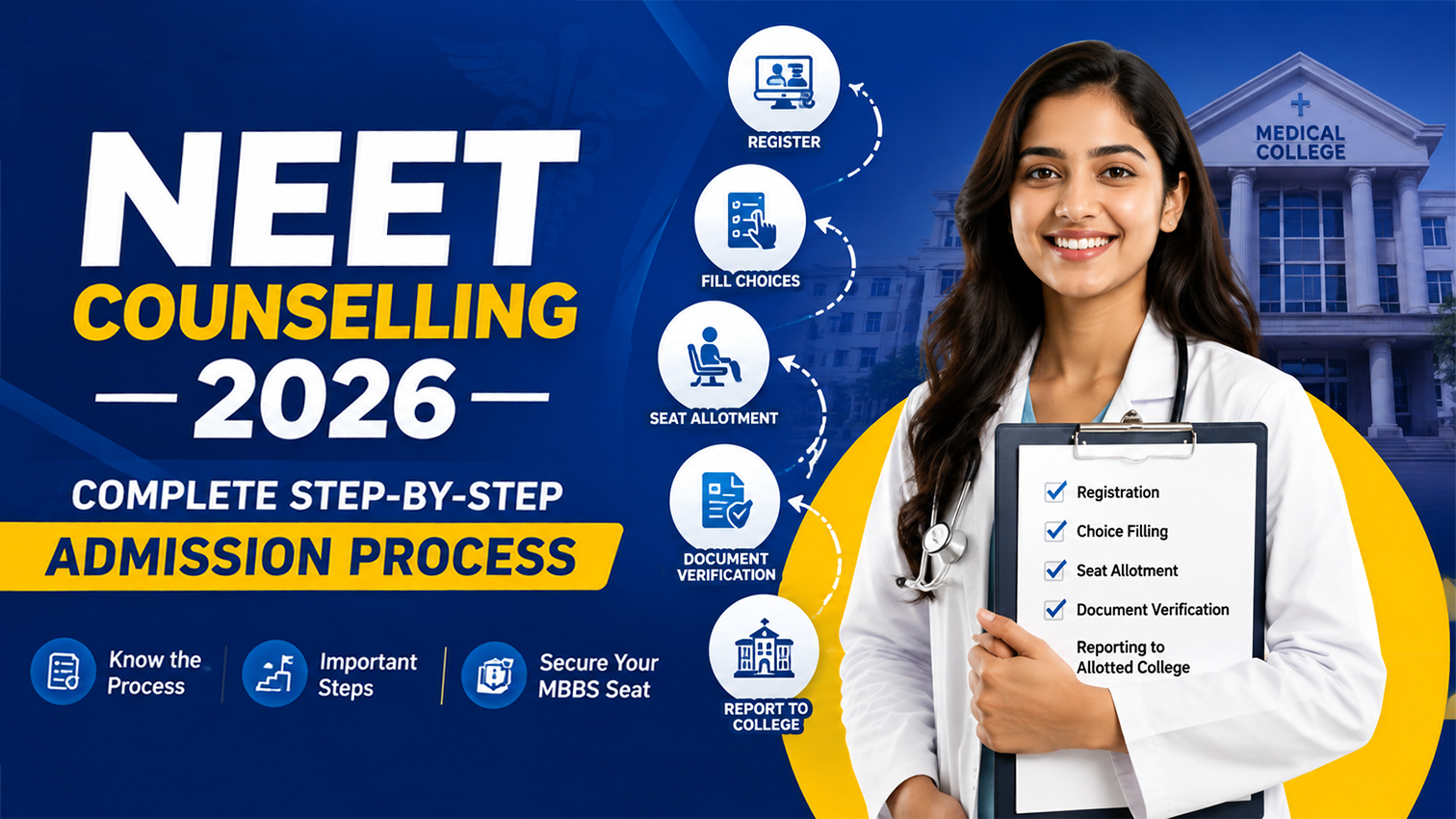
Step-by-Step: How NEET Counselling 2026 Works
Step 1 — Register on the correct portal. Your NTA registration data is already pre-populated at MCC, so stick to the same mobile number and email ID you used during NEET registration, since that’s where your OTPs will land. MCC treats whatever information you submit as self-certified, and it won’t entertain requests later to change your name, date of birth, category, or contact details.
Step 2 — Pay the registration fee and security deposit. For AIQ, central universities, AFMC, ESIC, AIIMS, JIPMER, and B.Sc Nursing seats, UR/EWS candidates pay ₹1,000 plus a refundable ₹10,000 security deposit, while SC/ST/OBC/PwD candidates pay ₹500 plus a ₹5,000 deposit. Deemed universities are a different scale entirely — ₹5,000 fee plus a ₹2,00,000 refundable deposit. If you’re applying across both categories of seats, you don’t pay twice; the higher applicable fee covers you.
Step 3 — Study the seat matrix before filling choices. Look closely at last year’s closing ranks for your specific category, not just which colleges sound impressive. A preference list built on actual data holds up a lot better than one built on wishful thinking.
Step 4 — Fill and lock your choices. List as many colleges as you’re genuinely willing to consider, in strict order of preference — the system will allot the highest-ranked choice it can match to your rank. If you don’t lock your choices manually, they usually get auto-locked when the window closes, and that’s not a risk worth taking on something this important.
Step 5 — Check the allotment result and decide Freeze or Float. This is the decision covered above, and it deserves a full day of thought rather than a rushed call. Talk it through with someone who’s actually been through a previous counselling cycle if you can.
Step 6 — Upload documents and report. Keep clear scans of the following ready well before your window opens:
- NEET UG 2026 admit card and scorecard
- Class 10 marksheet and certificate (for date of birth)
- Class 12 marksheet and passing certificate
- Photo identity proof (Aadhaar, PAN, passport, or driving licence)
- Eight to ten passport-size photographs matching your NEET application photo
- Provisional allotment letter
- Category certificate in the prescribed central format, where applicable
- For PwBD candidates: an eligibility certificate from an MCC Medical Assessment Board, a permanent UDID card, and the prescribed affidavits
Step 7 — Move to the next round if eligible. If you registered in Round 1 and didn’t get a seat, you don’t need to register again for Round 2 — you stay in the pool. Fresh registration is only needed for those who sat out earlier rounds, and everyone needs a fresh registration for the Stray Vacancy Round, no exceptions.
Reservation Under the All India Quota
In the 15% AIQ, the breakup of the reservation will be as follows: SC 15%, ST 7.5%, OBC-NCL 27% (against central OBC list), EWS 10% and PwD 5% (horizontal reservation) as on date. State quota breakup would be as per policy prescribed by the state and hence for Rajasthan domicile candidates it will be necessary to refer the brochure of the state for any reservation specific to that state.
For Rajasthan and Sikar Students: Don’t Neglect the State Leg
Sikar sends a large number of candidates into NEET every year, and a mistake that keeps repeating in this region is treating MCC counselling as the entire process. It isn’t. The 85% state quota is where most Rajasthan students actually land their seat, so register for both tracks. The state portal’s URL tends to change from year to year, so it’s worth confirming it through the Directorate of Medical Education directly rather than trusting a link forwarded in some coaching WhatsApp group.
Mistakes That Cost Students Seats
A handful of errors show up year after year, and most of them are avoidable. Filling too few choices and then finding no seat allotted in a round they could easily have cleared. Confusing the qualifying cut-off with the admission cut-off — scoring 213 marks makes you eligible for counselling, not for a government MBBS seat, and those are two very different thresholds. Treating the closing date as “till midnight” when it’s actually tied to a specific server time. Uploading a category certificate in a state format when the central format was required. Accepting a Round 3 seat without registering that resignation isn’t permitted afterward. Skipping state counselling registration entirely because AIQ registration felt like enough. And simply not joining an allotted seat — which forfeits the security deposit and can shut the door on further rounds altogether.
How Matrix NEET Division Helps
Counselling is where two years of preparation quietly pays off — or quietly unravels. At Matrix NEET Division in Sikar, students and parents are walked through a choice-filling strategy built on historical closing-rank data, the Freeze versus Float decision gets discussed case by case rather than handed down as a blanket rule, and document sets are checked before upload instead of after a rejection query comes back. The goal is straightforward: no student in our cohort should lose a seat over a procedural slip after all the work it took to get here.
Conclusion
NEET Counselling 2026 rewards preparation just as much as the exam did. It’s a procedural, rule-bound process, and that actually works in your favour once you understand the timeline, keep your documents ready, and fill your choices with some thought behind them. Treat counselling with the same seriousness you gave your exam prep, and you’ll be far less likely to look back on a decision made in a rush.
FAQs
Q1. When did NEET Counselling 2026 registration begin?
MCC opened Round 1 registration for All India Quota seats on 5 August 2026 at mcc.nic.in. State counselling was scheduled to begin separately from 13 August 2026 across states.
Q2. What is the difference between Freeze and Float?
Freeze means accepting your allotted seat and reporting to the college physically. Float means seeking an upgrade in the next round by submitting your willingness online, with document verification handled digitally instead.
Q3. How many rounds are there in NEET Counselling 2026?
MCC runs four rounds in total: Round 1, Round 2, Round 3, and the Stray Vacancy Round. Upgradation stays available only through Round 3, after which every decision becomes final.
Q4. Can I resign from a seat allotted in Round 3?
No. Resignation from a Round 3 seat isn’t permitted. Candidates who don’t report end up forfeiting their security deposit and become ineligible for any further counselling round.
Q5. What is the registration fee for NEET Counselling 2026?
For AIQ seats, UR/EWS candidates pay ₹1,000 plus a refundable ₹10,000 deposit, while SC/ST/OBC/PwD candidates pay ₹500 plus ₹5,000. Deemed universities charge ₹5,000 plus ₹2,00,000.
Q6. Do I need to register again for Round 2?
Not if you registered in Round 1 but didn’t receive a seat — you stay in the system automatically. Fresh registration is only for those who didn’t take part in Round 1.
Q7. Is MCC counselling enough for admission in Rajasthan?
No. MCC only handles 15% of the All India Quota along with deemed university seats. The remaining 85% state quota needs separate registration through the Rajasthan counselling board’s own portal.
About the Author